Inter-Activ: Presenting & Influencing

Call today on 01489 785448

Email: gmeikle@inter-activ.co.uk

PowerPoint Design - Eye Sweep Importance

If you're new here, you may want to subscribe to my RSS feed. Thanks for visiting!

Learning the simple principles in this post can start to transform your visual aids and dramatically improve the effectiveness of your presentation communication.

Research into how our eyes move when we scan a document or a slide has shown the following patterns:

  • Western people’s eyes go first to top left corner of the page.
    (This is a learned behaviour known as a conditioned carriage return)
  • The second move is a left to right sweep (reflexive cross sweep)

OK - that’s all very interesting but what’s it got to do with my PowerPoint presentation. Well it’s really important because, using these principles you can design slides which require the minimum number of eye sweeps making your slides easier and quicker to read.

The golden rule of slide design is “Don’t make your audience work”.

Applying this principle:

  • Use pictures to illustrate your messages. These can be taken in, in a single eye sweep.

  • If you must use text on your slides keep it clear and simple (maximum of four bullet points per slide and four words per point). This will allow your audience to take in the whole slide in one eye sweep and then return to you.
  • If you have to have more than four bullets, reveal them line by line using an animation build. Choose a left to right wipe animation as this follows the natural eye movement pattern.
[Slashdot] [Digg] [Reddit] [del.icio.us] [Facebook] [Technorati] [Google] [StumbleUpon]

Fear Of Public Speaking

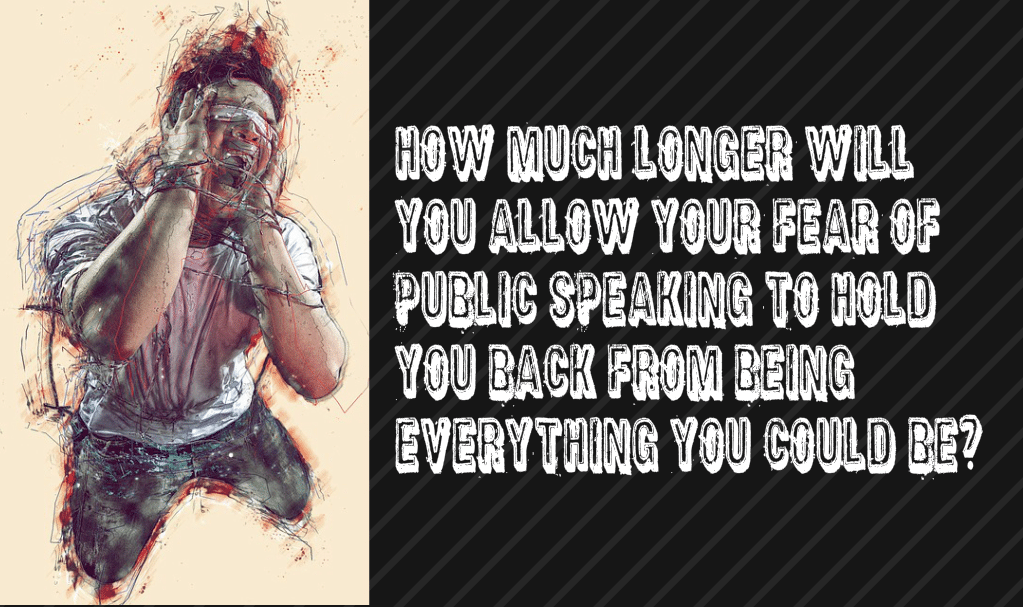
Last week I ran one of my open workshops in London and I had six fantastic participants and despite their professional experience and expertise, every one of them wanted to learn how to minimise their nerves. The fear of public speaking is a common and often paralysing condition.

As a departure from my usual session, I assigned them into pairs and asked them to share their worst fears relating to speaking in public.

  1. What were they really afraid of ?
  2. What would be the worst thing that could happen if what they feared actually came true?

Most peoples ultimate fear was that others would think less of them as a result of a poor public speaking performance. And when challenged as to what the worst outcome of this could be people struggled to find a really terrible outcome.

  • Nobody would actually die or get hurt if the made a bad presentation
  • They wouldn’t get the sack
  • People would empathise with them

What we fear rarely comes true. in fact the more we avoid what we fear, the more we inflate that fear and the more paralysed we become. Ultimately our fear ensures that very outcome that we thing it is trying to protect us from, occurs.

Now consider what would happen if ignored the fear and you gave a good presentation:

  • People would be impressed with your skills, knowledge and capabilities
  • You could influence more people more quickly
  • You might get positive feedback and encouragement
  • It would enhance your chances of promotion

Finally, cast your mind back to your childhood and slowly review your life to the present day. What sort of things have you done that, at one time in your life you were afraid of? Haven’t you successfully faced your fears countless times and survived?

There are lots of tools and techniques for tackling fear and nerves but it’s always good start to challenge your fear and face it headlong.

[Slashdot] [Digg] [Reddit] [del.icio.us] [Facebook] [Technorati] [Google] [StumbleUpon]

New Online Alternative To PowerPoint here Soon

The advent of widely available broadband connections has opened up a whole new world of web based applications that allow you to do many of the things you would have traditionally used a software package online without the need to buy or install the software on your PC.

Up until now the alternatives to PowerPoint have been limited but all that is about to change.
I saw a demo of a new package called Sliderocket which looks amazing. It hasn’t launched yet and is still in the testing phase but I think you will want to keep you eye on it.

Imagine never having to travel with your laptop in order to give a presentation again. Just develop it online, and just ask your host to have a projector and computer on hand with a fast broadband connection. You can then just fire up the browser, sign in to Sliderocket and off you go. Stunning graphics, slick, easy to use visual effects and no more boring PowerPoint!

Useful links:
www.sliderocket.com

Existing alternatives to PowerPoint
Daksh Sharma’s blog

[Slashdot] [Digg] [Reddit] [del.icio.us] [Facebook] [Technorati] [Google] [StumbleUpon]

Three Ways To Practice Your Presentations

We all know that practice is the best way to perfect our skills. The problem is that most of us think that we are too busy to practice so we just “wing it” and hope for the best.

I see many people on my courses who started using this approach but have been put off presenting for life as a result of the failures it often guarantees. As a result I have to spend quite a lot of time helping them get over their phobia of public speaking.

In order to stop more people having these problems here are three ways I recommend to develop your skills.

1) Rehearsal out loud: Nothing beats a couple of dry runs in front of some carefully selected colleagues or, failing that in front of a mirror. It’s a great way of ironing out problems, fine tuning content and getting familiar with your material before you have to do it for real in front of an audience that matters!

2) Toasters Clubs: Toastmasters are an international club for people who want to develop their public speaking skills in a supportive and friendly environment. It’s particularly useful for people who want to develop their skills but who don’t currently have a lot of opportunity to practice in their current job.

3) Mental Rehearsal: Whether you make the time to practice out loud or not, you have no excuse for not rehearsing in your imagination prior to the big day. Find a quiet spot - I often use the bathroom, and run a movie in your mind’s eye. Imagine that you are sitting in the audience watching and listening to yourself give the presentation to talk. See yourself looking confident, calm and convincing. Hear yourself sounding authoritative and congruent, with a clear voice and a nice medium pace delivery speed, punctuated by effective pauses for emphasis. Finally, hear the applause from the rest of the audience at the end of the presentation.

If you have time you can re-run this visualisation but this time, see it through the eyes of the speaker. See your audience responding just the way you want them to. hear your voice strong, confident and powerful. Feel the initial nerves quickly drain away as you start to really enjoy the process of engaging with your audience.

Follow one or all of these simple suggestions and you can learn to enjoy rather than fear the art of public speaking.

[Slashdot] [Digg] [Reddit] [del.icio.us] [Facebook] [Technorati] [Google] [StumbleUpon]

Wise Words From Perry Marshall

For some time now I’ve been subscribed to Internet marketing guru Perry Marshall’s Ezine but like many of us I don’t always read them - I get so many of these things that I can’t read everything - Right!

Well for some reason, I decided to open Perry’s most recent email expecting another lesson on how to use Pay per Click Advertising or some other such Internet marketing tool. Instead I read a little piece that touched me to the core. I liked it so much that I felt I should share it with you.

“Gavin,
Recently, I consulted with a student who had invested heavily in a business which was now making money but involved dealing with seedy individuals.
He was very conflicted about this. He’d put quite a bit into this venture. It was profitable, thus doubly hard to walk away from. But he didn’t feel good about what he was selling or who his customers were. His head and his gut were duking it out.
I don’t like just coming out and telling people what to do in situations like this. Here’s what I did say to him…
One of the most valuable skills I’ve honed is the ability to listen to my gut.
I learned this the hard way. There was an investor in the company I worked for who I personally liked but every time he’d call I’d feel a subtle, almost imperceptible wave of fear. Only much later did I realize his mission was to slice my fingers off one bloody joint at a time.
My head didn’t know it, but my gut did.
Ignoring my gut was a costly mistake.

Your gut can signal good people to you, too. When I interviewed Mendy Butler, who is now my Most Excellent Customer Service Person, I didn’t know her at all. My head just wasn’t sure about her. But as she got up to leave, a cool song started playing in my head. “Time and Motion just cranked up, that means we likes Mendy.” I did follow through and check all her references to be certain, but hearing that song in my head was the green light that she was the right gal for the job.

At my Chicago seminar, David Bullock stole the show. I got waves of raves about his presentation about Taguchi and online testing and tracking. He was totally tuned in with great information. He was entertaining, fun, even arresting.

You know what?
He’d never had any speaker training.
He’d never spoken to a seminar audience before.
He’d never even been to that kind of seminar before.
But I made him my keynote speaker and he totally rocked.
My gut told me to feature him.
He’s now got speaking invitations from major seminar promoters all over the biz.

It’s not easy at first to discern the conflicting voices inside. But little by little you begin to see through the haze and hear that inner voice more clearly.

I told my student that if he ignored his gut today it would be harder to detect its voice at all tomorrow.
Never disconnect your most reliable instruments.
I think he’ll do the right thing. And in the process he will teach his Inner CFO a lesson: We’re in charge of the money here, boys. The money is not in charge of us.

Small seeds grow and multiply. Little hinges swing big doors. Seemingly insignificant choices have far-reaching consequences. A decision to heed your best instrumentation and become even more reliant on it instead of less, benefits you in unforeseeable ways.

Listen to your gut.
Perry Marshall

See what I mean!
Have a great weekend and look out for those little gut signals.

[Slashdot] [Digg] [Reddit] [del.icio.us] [Facebook] [Technorati] [Google] [StumbleUpon]

A Sneaky Trick By The Swimming Pool People

It’s amazing what you can learn about sales in the most unusual places!

I wish I made time to go to the swimming pool more often but I don’t. This afternoon however I decided to take a little time away from the PC and have a swim at my local leisure centre.

Despite it being the school holidays and the pool being full of screaming kids and anxious parents, they had still cordoned off two lanes for “serious swimmers” and so I got my exercise. The problems only arose when I came to leave after having showered and changed. The usual entry/exit doors now had turnstiles and were marked “No Exit”.

Puzzled and a little confused I followed the new arrows directing me down a corridor I’d never ventured before and through a set of doors into - guess what - The Cafe! Now there is no escape from the centre without going through the cafe and the temptation of spending some of my hard earned cash on a coffee, sandwich or a muffin!

Even the leisure centre has fallen in line with every other “attraction” which cunningly forces you to leave only via the shop!

So what can we learn from this little story?

Well first off - It’s a highly effective strategy - I bought a coffee and lots of other parents were there buying drinks and food for their little angels too.

So how can we apply this to sales and marketing. Well here’s a couple of ideas to get you started.

If you sell products on your web site, how good is your site at leading your visitors to your “shop”? The more links you have to other pages on your site or indeed to external sites, the easier you are making it for people to exit away from your selling messages. That’s why so many Internet marketers use product or service specific micro sites for selling. - The only links you see in these types of sites are to the shopping cart or to further product related sales information.

But what if you don’t sell via the web? Well in my years as a salesperson, sales trainer and coach I have seen many salespeople have wonderful “conversations”with their clients without ever asking the customer if they are ready to buy. If you don’t ask closing questions, you are allowing your prospects to potentially exit your “store” without passing the cashier!

[Slashdot] [Digg] [Reddit] [del.icio.us] [Facebook] [Technorati] [Google] [StumbleUpon]

Know Your Product Or Service

I’m proud to be a salesperson and a sales trainer.

Really! I think it is a very valuable and worthwhile profession and I pride myself on helping people get the right solutions.

What really annoys me is when I see poorly trained, unmotivated or unprincipled salespeople giving customers a bad experience which in turn leads to a bad reputation for the profession as a whole. One of my particular pet hates is when salespeople don’t know the basics about their product or service.

With increasing complexity it’s not always possible to know everything but I’m often astounded by how little some salespeople know about their product and the competition.

Yesterday a friend told me about she asked a shop assistant what the difference was between two different brands of table tennis balls one of which was priced at £4 and the other at £20.

After a short pause the young lady’s responded in all seriousness -
“Well one costs £20 and the other costs £4″

Are you as up to date on your products and your main competitors as you need to be?

[Slashdot] [Digg] [Reddit] [del.icio.us] [Facebook] [Technorati] [Google] [StumbleUpon]

Charisma Engagement & Folk Music!

This past weekend I watched more than 30 performers take to the stage and try to engage the audience. A few excelled whereas many did no. So what is the difference that makes the difference?

The Wickham Festival is a folk based music festival and has a wide range of acts from relatively obscure solo performers to headline acts like The Saw Doctors. To me it was clear that there were three main differences between the performers who did this well and those who did not.

1) Desire
2) Passion
3) Empathy

Let’s look at each of these in turn and I’ll try to explain what mean.

Desire: Here I specifically mean a real desire to connect to, and build a relationship with, their audience. Strange as it may seem, a number of acts, though undoubtedly talented, seemed to be more interested in their music than in their audience and the result usually was a performance that was flat and which left the audience unmoved. Contrast this with those performers who clearly wanted to relate with their audience and the effect was startling.

Passion: When somebody is passionate about their message or their music, that emotion comes through not only in what they say, but the way they say it. I find it hard to understand how some musicians can stand on stage and play an energetic, uptempo, toe tapping piece and yet have a bored expression on their face. They look like they are going through the motions. Maybe its because they have been performing this set non stop all around the country for the last 6 months? But whatever the reason, the effect is that their indifference to their material is infectious and the audience are not moved in the same way that they are when the performer is fully engaged in their performance and gives it as if it were the first time.

Empathy: Here I mean taking the trouble to connect verbally with your audience at the beginning of your performance. To acknowledge where they are and to express your understanding of that position. I was fascinated when Hazel O’Connor was performing and early on in her set she invited the audience to join in on the next song. Rather than just telling everyone to join in she invited us. Moreover, she empathised by saying that not everyone likes to join in and if you do feel self conscious, that’s OK, it’s not compulsory. The result of her empathetic preamble was that many more people sang along with her. She has taken the time to acknowledge the state of her audience.

[Slashdot] [Digg] [Reddit] [del.icio.us] [Facebook] [Technorati] [Google] [StumbleUpon]

©2008 Inter-Activ Presenting and Influencing | Presentation skills training & sales coaching Dorset Hampshire & Sussex